
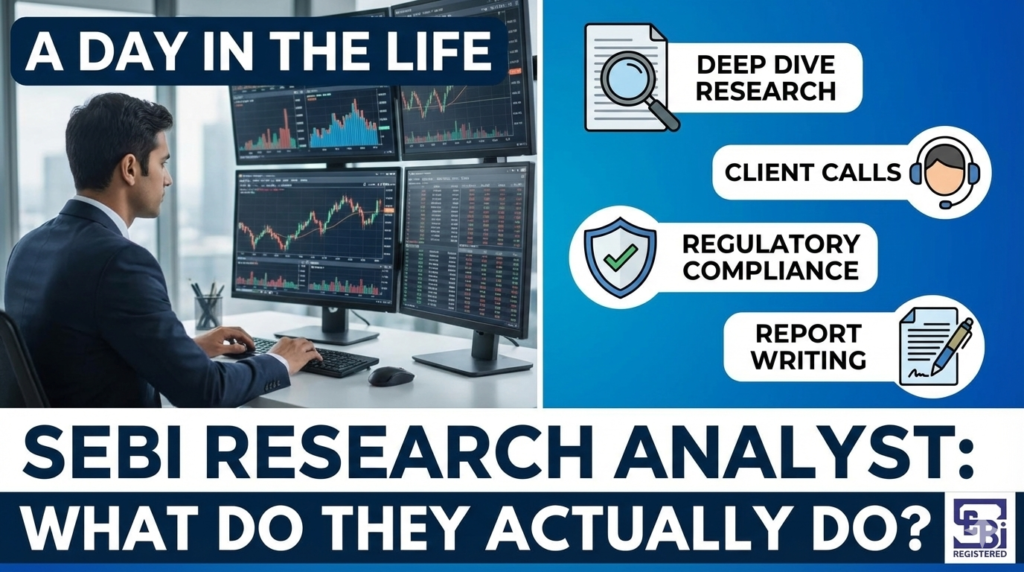
The Finance Chemist: Inside the Mind of a SEBI-Registered Research Analyst
In the laboratory of the Indian capital markets, information is the raw reactant. Every day, millions of data points—from RBI repo rate tweaks to a small-cap company's inventory turnover—swirl in a volatile mix. For the average investor, this mixture can be either explosive or completely inert. The Research Analyst (RA) serves as the critical catalyst in this equation, using structured frameworks to transform unstable data into a purposeful investment strategy.
Being a SEBI-Registered Research Analyst isn't about staring at charts or trying to predict the next multi-bagger stock. It is a profession defined by strict legal accountability, rigorous ethics, and a binding Code of Conduct under the SEBI (Research Analysts) Regulations, 2014. Unlike a social media influencer, an RA operates under a regulatory microscope where every single claim requires a documented basis.
Here is a look behind the scenes at what actually happens in the daily life of a professional market selector.
A Day in the Life of a Research Analyst
The day begins long before the opening bell. An analyst must first take the temperature of the global and domestic economy.
Macro-Economic Surveillance
We start by gathering data from government statistics, the RBI, and international agencies like the IMF. We're looking for shifts in GDP, inflation, and interest rates. Think of these variables as the pressure and temperature of a chemical reaction; high inflation acts as heat that erodes purchasing power, and we must figure out how that heat alters the specific industries we cover.
News Filtering
Next, we sift through regulatory filings and annual reports to identify Unpublished Price Sensitive Information (UPSI). As professionals, we cannot legally trade on this information. Instead, we use a "Mosaic Analysis"—combining small, non-public puzzle pieces with public data to form a legal, analytical conclusion.
Once the market opens, our focus shifts to deep-dive fundamental analysis. This is the core process where we shortlist securities based on comprehensive study.
Quantitative Dimensions
We pore over balance sheets, income statements, and cash flows. Beyond simple profits, we calculate Return on Equity (ROE) to see how efficiently a company uses shareholder capital. We also analyze the reality of the cash flow: is the company generating mere paper profits, or actual operating cash?
Qualitative Dimensions
Numbers only tell half the story. We rigorously evaluate management ethics, business models, and corporate governance. If a management team is known for painting an overly rosy picture, their claims must be cross-verified through independent research.
The Selector's Role
Much like a consumer comparing smartphone battery life and camera specs, we evaluate companies based on their competitive moat and pricing power. This is where qualitative judgment meets quantitative rigor.
A huge portion of an analyst's value comes from direct industry interaction, though this is heavily governed by strict interaction principles.
Due Diligence
We meet with company officials, but we also perform "channel checks." This means talking directly to suppliers, distributors, and customers to verify if management's claims hold up in the real world. It's detective work disguised as professional analysis.
Independence and Neutrality
Under SEBI regulations, our opinions must remain totally unbiased. If I meet a company promoter, my analysis must be driven by factual data, not personal rapport or a CEO's charisma. This is where the professional standard separates us from casual investors.
The Arms-Length Relationship
For analysts working at large firms that also handle investment banking, we must respect the "Chinese Wall." This physical and functional barrier ensures that confidential banking information doesn't contaminate public research reports.
The market may close at 3:30 PM, but the analyst's most critical work—documentation—is just beginning.
The Rationale Requirement
Under Regulation 25, an RA must maintain a clear rationale for every recommendation. I cannot simply say, "Buy because the chart looks good." I must document the why, linking my conclusion back to fundamental analysis, valuation principles like Discounted Cash Flow (DCF), and industry drivers.
Risk Metrics
We don't just throw out a price target. We measure risk using tools like Beta (sensitivity to market moves) and the Margin of Safety (the financial cushion between a stock's intrinsic value and its current market price). These aren't optional—they're regulatory requirements.
Beyond the Charts: The Invisible Responsibilities
Most investors only see the final "Buy" or "Sell" rating, but the hidden compliance tasks are what truly separate a registered professional from a "finfluencer."
Managing Conflicts of Interest
This is a non-negotiable regulatory pillar. If I, or my immediate relative, hold even a single share of a company I am writing about, I am legally required to disclose it in my report. This isn't a suggestion—it's law.
Trading Restrictions (The 30/5 Rule)
An RA cannot simply pump and dump a stock. Under Regulation 16, analysts and their associates are prohibited from trading a recommended security for thirty days before and five days after the publication of a report. Furthermore, we can never trade contrary to our own active recommendations.
No Front-Running
Buying a stock for your personal portfolio just before releasing a "Buy" recommendation to clients is a massive violation. Registered analysts are legally bound to act in good faith. This is the trust that separates us from random Twitter advice.
SEBI Regulation Framework for Research Analysts
- Regulation 24: General Prohibition against Fraudulent and Unfair Trade Practices
- Regulation 25: Requirement of Adequate Documentary Basis
- Regulation 26: Disclosure of Conflicts of Interest
- Regulation 16: Trading Restrictions (30/5 Rule)
- Regulation 27: Code of Conduct for Research Analysts
Myth vs. Reality in Research Analysis
❌ Myth: Analysts just guess where the stock price will go.
✓ Reality: Analysts use strict valuation principles, like calculating the present value of future free cash flows. Every single price target requires an adequate, documented basis. Guessing is not just unprofessional—it's illegal.
❌ Myth: If an analyst says "Buy," it's guaranteed to go up.
✓ Reality: Research is an exercise in probability, not certainty. We provide highly educated estimates based on current data and catalysts. Markets are inherently unpredictable; our job is to reduce uncertainty through structured analysis.
❌ Myth: YouTubers and SEBI RAs basically do the same thing.
✓ Reality: A YouTuber optimizes for clicks and visibility. A SEBI RA has legally mandated certifications to ensure a minimum knowledge benchmark, facing severe penalties, suspension, or cancellation of their registration if they mislead the public. The accountability gap is enormous.
Key SEBI Regulations Governing Research Analysts
The following table outlines the critical regulations that define the professional standards for SEBI-registered research analysts:
| Regulation | Key Requirement | Violation Consequence |
|---|---|---|
| Regulation 24 | Prohibition on Fraudulent & Unfair Practices | Suspension or Cancellation of Registration |
| Regulation 25 | Adequate Documentary Basis for Recommendations | Fines, Suspension, Cancellation |
| Regulation 26 | Disclosure of Conflicts of Interest | Monetary Penalties |
| Regulation 16 | 30/5 Trading Restrictions Rule | Fines, Suspension |
| Regulation 27 | Code of Conduct | Registration Cancellation |
| Regulation 28 | Compensation Standards (Bonus Tied to Performance, Not Transactions) | Fines, Suspension |
SEBI-Registered Analyst vs. Financial Influencer
Understanding the distinctions between a regulated professional and an unregistered content creator is essential for investors:
| Aspect | SEBI-Registered Analyst | Financial Influencer (Unregistered) |
|---|---|---|
| Regulatory Oversight | Subject to SEBI (RA) Regulations, 2014 | Minimal to No Oversight |
| Documentation Requirement | Every recommendation must have adequate documentary basis | No Documentation Required |
| Conflict Disclosure | Mandatory Disclosure in Every Report | Often Omitted or Hidden |
| Trading Restrictions | 30 days before, 5 days after recommendation | Often Front-Runs Their Own Recommendations |
| Accountability | Subject to Penalties, Suspension, Cancellation | Limited Accountability |
| Primary Incentive | Reputation and Long-term Track Record | Views, Likes, Subscriptions |
| Certification | Legally Mandated Knowledge Benchmark | No Standard Certification |
Conclusion: The Accountability Gap
Ultimately, the difference between a SEBI-registered professional and an unregistered influencer comes down to incentive structures. An RA's primary mission is to act as a disciplined selector, governed by a framework demanding honesty, diligence, and confidentiality.
Think of the stock market as a massive chemistry lab. An unregistered influencer is like a hobbyist mixing chemicals in their backyard—they might create a cool spark, but without safety gear, they are likely to blow up your capital. A SEBI Registered Research Analyst is the professional chemist in a certified lab. We follow strict protocols, wear our protective gear, and document every reaction to ensure that the investment advice you receive is as stable and reliable as the science of finance allows.
The Bottom Line for Investors
When evaluating investment advice, ask yourself:
- Is this person SEBI-registered?
- Do they disclose conflicts of interest?
- Can they provide a documented rationale for their recommendation?
- What are they being paid for—transactions or performance?
These simple questions can protect you from joining the crowd of investors who lose money following unqualified advice.
📌 Key Takeaways
- SEBI-Registered Research Analysts operate under strict regulatory oversight and legal accountability
- Every recommendation must have an adequate documentary basis (Regulation 25)
- The 30/5 Trading Restriction Rule prevents analysts from profiting off their own recommendations
- Conflicts of interest must be disclosed in every report
- The Chinese Wall separates research from investment banking to prevent bias
- SEBI analysts are bound by a Code of Conduct requiring due skill, care, and diligence
- Financial influencers operate without comparable regulatory safeguards
- Professional analysts build decisions on fundamental analysis, not speculation
- Always verify analyst credentials and disclosures before acting on recommendations
- The accountability gap between regulated professionals and influencers is massive
Want to Understand Market Professionals Better?
Subscribe to Finance Chemistry and receive insights into how the financial system actually works—from regulations to real-world analyst workflows.
Subscribe to Finance Chemistry