
Live Silver Rates in India Today (1kg, 100g, 10g, 1g)
| Silver Purity / Form | Fineness & Use Case | Rate Today (1 Kilogram (Benchmark))* | Rate Yesterday* | 24H Net Change |
|---|---|---|---|---|
| 999 Fine Silver | 99.9% Purity (BIS Hallmarked Bullion & ETFs) | ₹1,12,500 | ₹1,15,884 | ▼ ₹3,384 (-2.92%) |
| 925 Sterling Silver | 92.5% Purity (Jewellery & Pooja Utensils Standard) | ₹1,04,062 | ₹1,07,192 | ▼ ₹3,130 (-2.92%) |
| 999 Bullion + 3% GST | Legal Retail Landed Invoice Price | ₹1,15,875 | ₹1,19,361 | ▼ ₹3,486 |
Major City Bullion Rates Today (1kg 999 Fine Silver, Ex-GST)
Regional Sarafa Association Benchmarks* Note: Benchmark bullion rates exclude 3% GST unless specified, local transportation premiums, and retail making charges (15% - 25% on silverware/ornaments). IBJA Mumbai wholesale closing serves as the clearing price for physical trades and MCX deliveries. Rates refresh automatically every morning.
Executive Research Brief: Silver (chemical symbol Ag, atomic number 47) occupies an utterly unique dual identity in modern macroeconomics. Unlike gold—which sits primarily in central bank vaults and bank safety deposit lockers as a pure monetary store of value—silver is both an ancient monetary hedge and an indispensable, irreplaceable industrial workhorse. Today, over 58% of global silver annual demand is consumed by green technology: next-generation solar photovoltaics (TOPCon & HJT cells), electric vehicle (EV) powertrains, and high-density artificial intelligence (AI) server hardware. In this institutional guide, we demystify live silver rates, explain why rates differ across states and shops, expose the hidden retail silverware trap, and contrast physical bullion against modern NSE Silver Exchange Traded Funds (ETFs) and post-Budget 2024 taxation.
1. Live Silver Rates Today in India: Benchmark Prices Explained
When you open a financial newspaper or monitor Indian bullion markets, you will notice that silver is quoted primarily by the kilogram (1,000 grams), in contrast to gold which is universally measured per 10 grams or 1 tola. For retail investors and festive buyers, bullion dealers and jewellers also break quotes down into 100 grams, 10 grams, 1 gram, and 1 tola (12 grams).
The interactive rate terminal above tracks the authentic daily benchmark published by the India Bullion and Jewellers Association (IBJA) in Mumbai, alongside real-time parity from the Multi Commodity Exchange (MCX). Before placing a single rupee into physical silver or an ETF, it is critical to distinguish between three core quoting standards:
- 999 Fine Bullion (Ex-GST Wholesale): Represents 99.9% pure silver ingots or cast bars traded among institutional bullion importers and accredited refiners. This is the pure metal price.
- 925 Sterling Silver: The international alloy standard containing 92.5% silver and 7.5% copper/zinc. This is the baseline used for silver jewellery, pooja thalis, glasses, and decorative idols.
- Retail Bullion (With 3% GST): The legal invoice price you pay across showroom counters. Under Indian tax laws, precious metals attract a flat 3% Goods and Services Tax (GST) applied directly to the total value of the metal.
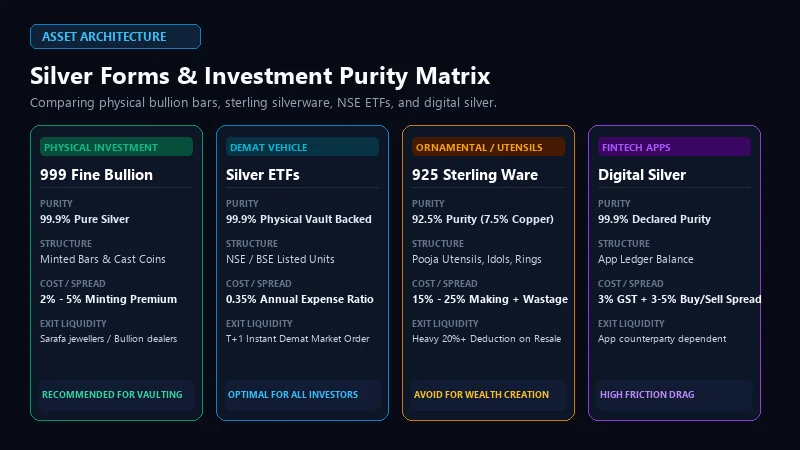
2. Why Is the Silver Rate Different Everywhere? The Five Market Truths
One of the most persistent confusions among Indian retail investors is why silver prices differ across different websites, television tickers, state borders, and neighbourhood jewellery showrooms. You might check a global website like Kitco or Goldprice.org and see silver quoted at ₹95,000 per kg, while your local jeweller in Lucknow, Kanpur, or Varanasi demands ₹1,16,000 per kg, and a television news ticker shows ₹1,12,500 per kg.
Is someone deceiving you? As an equity research analyst, let me assure you that these spreads are not arbitrary. They are governed by five distinct structural mechanics of the global and Indian precious metals supply chain:
Truth 1: International Spot Price vs. Domestic Landed Bullion (Import Parity)
India does not possess vast commercial silver mines; more than 80% of our domestic silver demand is imported through official sea and air cargo vaults from the United Kingdom, Switzerland, the United Arab Emirates, and Hong Kong.
When you check international financial websites, they display the London Bullion Market Association (LBMA) or COMEX (Chicago Mercantile Exchange) spot price quoted in US Dollars per troy ounce (1 troy ounce = 31.1034768 grams). If you convert that dollar spot price directly into Indian Rupees using the raw USD/INR exchange rate, you get what traders call the un-imported raw price.
To land that silver onto Indian soil, authorized banks and premier trading houses must pay:
- Basic Customs Duty (BCD): The national tariff levied on imported bullion (rationalized to 6% in Union Budget 2024).
- Agriculture Infrastructure and Development Cess (AIDC): An additional 1% duty.
- International Air Freight, Marine Insurance & Port Clearance: Secure transit in bulletproof air containers.
- Domestic Goods & Services Tax (GST): 3% on the landed value upon domestic clearance.
Because of these statutory duties and transit costs, the official domestic Indian landed bullion price is naturally ₹15,000 to ₹20,000 per kilogram higher than raw international currency conversions.
Truth 2: Mumbai IBJA Baseline vs. State Sarafa Associations
The national benchmark is established twice every business day (at 12:00 PM and 5:00 PM) by the India Bullion and Jewellers Association (IBJA) in Zaveri Bazaar, Mumbai. IBJA polls top accredited bullion wholesalers and calculates a volume-weighted average price.
However, physical silver is heavy and bulky. A single standard commercial brick of silver weighs 30 kilograms (worth approximately ₹33 to ₹35 Lakhs). Transporting hundreds of kilograms of silver from Mumbai or Gujarat ports to interior cities like Lucknow, Meerut, Patna, or Jaipur requires armored logistics (cash-in-transit vans like SIS or Brink's), armed guards, and heavy transit insurance.
Regional associations—such as the Uttar Pradesh Sarafa Association, the Delhi Bullion & Jewellers Association, and the Madras Jewellers Association—add these legitimate physical transport costs and local state supply-demand premiums to their daily morning circular. That is why silver in Chennai or Lucknow usually trades ₹300 to ₹900 per kg higher than in Mumbai port vaults.
Truth 3: 999 Fine Bullion vs. 925 Sterling Silverware
Purity dictates intrinsic worth. When you buy a certified silver bar for wealth preservation, it must be 999 Fineness (99.9% pure silver).
However, pure silver is naturally soft and ductile—it easily bends, scratches, and dents. Therefore, jewellers cannot craft durable dining plates, spoons, cups, heavy ankle chains (payals), or religious idols from 999 silver. They melt it with 7.5% copper or zinc to produce 925 Sterling Silver.
Naturally, 1 kilogram of 925 silver contains only 925 grams of pure metal. Its intrinsic raw material cost is 7.5% lower than a 999 bullion bar (e.g., ₹1,04,062 vs. ₹1,12,500). If a showroom quotes a single flat rate without stating fineness, you may inadvertently pay 999 pure prices for 925 alloyed silver.
Truth 4: Showroom Making Charges and Melting Wastage
Unlike raw bullion bars—which carry minimal minting premiums (typically 2% to 4%)—silver jewellery, decorative artifacts, and pooja utensils carry showroom making charges ranging from 15% to 30%.
Furthermore, many traditional unorganized jewellers charge a "melting wastage deduction" (tanka or polish loss) of 5% to 15% when you sell the item back. When an investor buys a 1 kg silver tea set for ₹1,35,000 (metal + 20% making + 3% GST), its immediate melt-down liquidation value on the street is barely ₹1,04,000. That instant 23% capital haircut takes years of silver price appreciation just to break even!
Truth 5: Wholesale Physical Spread vs. Demat Silver ETFs
Finally, silver prices differ depending on whether you trade through a retail counter or the National Stock Exchange (NSE). In physical retail, the dealer buys at wholesale and sells at retail, baking in a 3% to 6% bid-ask spread to cover retail showroom rent, security, and staff salaries.
In contrast, an NSE-listed Silver ETF (such as Nippon India Silver ETF - SILVERBEES) trades electronically on the stock exchange. The underlying mutual fund buys multi-ton institutional bullion wholesale directly from LBMA-accredited refiners at zero retail markup, holding it in institutional vaults audited by SEBI. The investor trades at pure live net asset value (NAV) with tight bid-ask spreads of less than 0.10%.
| Market Venue / Pricing Layer | Underlying Purity | Illustrative Rate (1kg) | Key Pricing Driver / Components Included |
|---|---|---|---|
| London / COMEX Spot (USD converted) | 999 Fine Bullion | ₹95,200 | Pure international price; excludes Indian tariffs, port handling & GST. |
| IBJA Mumbai Wholesale Baseline | 999 Fine Bullion | ₹1,12,200 | Includes 6% BCD + 1% AIDC + Mumbai port clearing. Excludes GST. |
| UP / Delhi Regional Sarafa Board | 999 Fine Bullion | ₹1,12,500 - ₹1,12,650 | IBJA base + armed logistics, transit insurance, and regional buffer. |
| Retail Physical Bar (+ 3% GST) | 999 BIS Hallmarked | ₹1,15,875 | Final showroom legal invoice price with mandatory government tax. |
| Retail Silver Utensils / Silverware | 925 Sterling Alloy | ₹1,24,800 - ₹1,35,000 | 925 metal cost + 15% to 25% making charges + 3% GST on total. |
3. The Chemistry of Silver: Why Industrial Physics Drives Its Bull Market
To understand why institutional equity research analysts view silver with immense enthusiasm over this decade, one must examine its fundamental physical and chemical properties. In high school chemistry, we learned that elements in Group 11 of the periodic table—copper, silver, and gold—are exceptional conductors of heat and electricity.
Among all 118 known elements in the universe, silver has the highest electrical conductivity, the highest thermal conductivity, and the highest optical reflectivity. Copper is widely used for domestic building wiring only because it is cheaper, but when extreme performance, high switching frequencies, and zero electrical resistance are mandated, silver is physically irreplaceable.
This elemental reality has transformed silver from a sleepy heirloom metal into an indispensable high-tech industrial commodity:
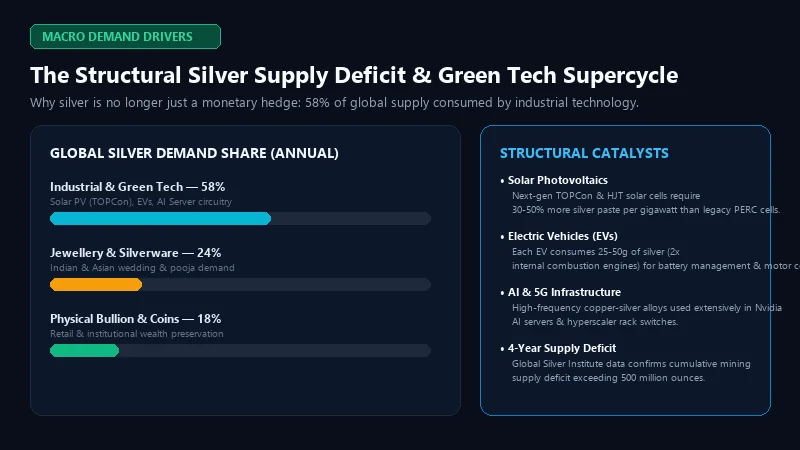
1. Next-Generation Solar Photovoltaics (TOPCon & HJT Cells)
Solar panels do not function without silver paste. The fine grid lines on the surface of every silicon solar cell that conduct electricity generated by sunlight are printed using silver metallization paste.
Over the past three years, the global solar industry has completed a monumental technological transition from legacy Passivated Emitter and Rear Cell (PERC) technology to Tunnel Oxide Passivated Contact (TOPCon) and Heterojunction (HJT) solar cells. While TOPCon and HJT cells deliver higher sunlight-to-power efficiency, they require 30% to 50% more silver paste per gigawatt of capacity. The International Energy Agency (IEA) projects that solar manufacturing alone will consume over 20% of total annual global silver mining output over the coming decade.
2. The Electric Vehicle (EV) Transition
A conventional internal combustion engine (petrol or diesel car) contains approximately 15 to 25 grams of silver, predominantly in spark plugs and basic switches.
In stark contrast, a modern battery electric vehicle (EV)—such as those engineered by Tesla, BYD, or Tata Motors—contains 25 to 50 grams of silver. Silver is heavily utilized in high-voltage battery management systems (BMS), inverter power modules, silicon-carbide semiconductor packaging, regenerative braking sensors, and DC fast-charging connector points. As global automotive production shifts decisively towards electrification, automotive silver demand is scaling at a compound annual growth rate (CAGR) exceeding 12%.
3. AI Datacenter Hardware, High-Speed 5G & Defense
Artificial intelligence clusters powered by Nvidia Hopper (H100/H200) and Blackwell (B200/GB200) superchips draw unprecedented electrical wattage. To prevent signal attenuation and catastrophic thermal throttling at 800-gigabit network switching speeds, server backplanes and optical transceivers rely on high-purity silver-coated copper interconnects. Furthermore, satellite communication arrays and advanced guided defense missiles mandate silver-zinc aerospace batteries for ultra-high energy discharge rates.
The Structural Mining Deficit
According to the World Silver Institute, global silver demand has outstripped total mining and recycling supply for four consecutive years (accumulating a deficit exceeding 500 million ounces). Because over 70% of silver is mined as a byproduct of copper, lead, and zinc mines, primary silver miners cannot easily increase output simply because silver prices surge. This rigid supply curve combined with green industrial demand creates a powerful structural floor for long-term valuations.
4. Four Ways to Invest in Silver in India: Vehicles Compared
Indian investors have multiple avenues to deploy capital into silver. Each vehicle exhibits distinct characteristics regarding security, costs, tax efficiency, and execution ease:
1. Physical Silver Bullion (Bars & Minted Coins)
Physical bullion represents direct, unencumbered ownership of physical metal. You buy minted 999 fine coins or 100g/500g/1kg bars from accredited refineries (such as MMTC-PAMP, BRPL, or authorized bank branches) or trusted local jewellers.
- Advantages: Zero counterparty risk; immune to banking freezes or technological grid disruptions; tangible heirloom asset.
- Disadvantages: Incurs 3% non-recoverable GST upon purchase; carries 3% to 6% minting and blister-packaging premiums; poses severe theft and storage risks; safe bank locker charges (₹2,500 to ₹7,000 annually) create steady cash flow drag.
2. Silver ETFs (Exchange Traded Funds) & FoFs — The Analyst's Choice
Approved by the Securities and Exchange Board of India (SEBI) in late 2021, Silver ETFs—such as Nippon India Silver ETF (Ticker: SILVERBEES), ICICI Prudential Silver ETF, and HDFC Silver ETF—have revolutionized silver investing in India.
- Mechanism: The mutual fund pools capital from investors and purchases physical 30kg commercial bars of 99.9% pure silver from LBMA-accredited refiners. The silver is securely vaulted in SEBI-regulated, insured vaults (such as Brink's or Malca-Amit) and audited semi-annually.
- Advantages: You buy and sell units directly through your Demat account (Zerodha, Groww, AngelOne) during market hours at live wholesale spot prices. No GST is charged on unit purchases! No making charges, no theft risk, no bank locker fees. Highly liquid; sell with one click and receive funds on T+1 settlement. Low annual expense ratio (typically 0.35% to 0.45%).
- Disadvantages: Requires a Demat and trading account; trades only during stock market hours (9:15 AM to 3:30 PM IST).
3. MCX Silver Commodity Futures & Options
For high-net-worth individuals and experienced derivative traders, the Multi Commodity Exchange (MCX) offers standardized silver futures contracts: Silver Mega (30 kg), Silver Mini (5 kg), and Silver Micro (1 kg).
- Advantages: High capital leverage (typically requires 12% to 15% margin); trades until 11:30 PM / 11:55 PM IST, tracking international COMEX and LBMA evening trading sessions in real time.
- Disadvantages: Leveraged derivative instruments carry extreme risk of total capital wipeout during flash crashes; contracts expire bi-monthly, forcing roll-over costs (contango drag); not suitable for long-term passive compounding.
4. Fintech "Digital Silver" (MMTC-PAMP / Augmont / SafeGold)
Available across payment apps like Google Pay, PhonePe, and Paytm, digital silver permits micro-investments starting at just ₹10.
- Advantages: Fractional micro-accumulation for beginners without needing a Demat account.
- Disadvantages: Substantial hidden friction! You pay 3% GST upon every purchase. Furthermore, digital gold/silver apps impose an aggressive 3% to 5% spread between their "buy price" and "sell price". Finally, if you hold digital silver beyond 3 to 5 years, platforms levy recurring annual vault custody charges, or force mandatory liquidation.
| Investment Parameter | Silver ETFs (NSE: SILVERBEES) | Physical 999 Bullion Bar | Fintech Digital Silver | 925 Silverware Utensils |
|---|---|---|---|---|
| Upfront Entry Cost | Zero (Pure Spot NAV) | 3% GST + 3% Minting | 3% GST + 2% Spread | 3% GST + 18% Making |
| Annual Holding Cost | 0.35% Expense Ratio | ₹3,000+ Bank Locker Fee | 0.4% - 0.8% after 3 yrs | Zero (Self storage) |
| Liquidity & Exit Speed | Instant (T+1 to Bank) | Moderate (Visit Jeweller) | Fast (App Cashout) | Poor (Melting Loss) |
| Purity Guarantee | 100% Vault Audited | BIS 6-digit HUID | Refiner Certified | Variable (925 or lower) |
| Analyst Verdict | BEST FOR WEALTH | SOLID VAULT HEDGE | HIGH FRICTION | AVOID AS INVESTMENT |
5. The Utensil and Silverware Trap: How 20% Making Charges Destroy Returns
Across Indian households, an entrenched cultural tradition equates purchasing silver plates, glasses, bowls, pooja diyas, and silver idols during Dhanteras and Diwali with "investing."
As an equity research analyst, let us perform the cold, hard mathematics of this practice. When you purchase decorative silverware from an upscale jewellery showroom:
- The Making Charge Penalty: Showrooms charge anywhere between ₹18 to ₹28 per gram in making charges (or 15% to 25% of the total silver weight). On a 1 kilogram silver dinner set costing ₹1,12,500 in pure metal, you pay an additional ₹22,500 in fabrication charges.
- The Compounded GST Impact: You pay 3% GST on the grand total (metal + making charge). That adds another ₹4,050. Your total cash outlay is ₹1,39,050.
- The Resale Meltdown Penalty: Five years later, you take that dinner set back to the market to convert it into cash. Under Indian Sarafa trade customs, the jeweller will never pay you back the ₹22,500 making charges or the ₹4,050 GST. Furthermore, because silverware is 925 sterling alloy, the jeweller will deduct an additional 5% to 8% for "melting loss, solder removal, and refining wastage."
Even if the benchmark silver market climbed 25% over those five years, your net realization after melting deductions will barely equal the ₹1,39,050 you initially paid. In real, inflation-adjusted terms, you suffered a catastrophic negative return!
6. The Gold-to-Silver Ratio (GSR): The Quantitative Valuation Model
Professional hedge funds and macro quantitative strategists rarely look at the absolute dollar or rupee price of silver in isolation. Instead, they track the Gold-to-Silver Ratio (GSR).
The formula is remarkably simple:
The GSR tells you exactly how many ounces (or grams) of silver are required to purchase one single ounce (or gram) of gold. Historically, in the Earth's crust, silver is approximately 19 times more abundant than gold. During the ancient Roman Empire and early American bimetallic monetary standards, the legal ratio was fixed between 12:1 and 16:1.
In modern floating fiat markets, the 30-year historical mean for the GSR has hovered around 65:1. Because both metals are driven by monetary inflation but silver carries superior industrial beta, the ratio oscillates in large, predictable macro cycles:
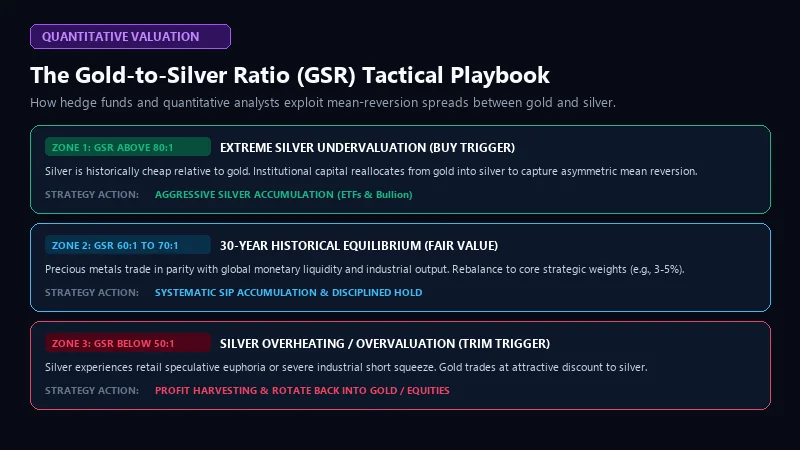
The Quantitative Trading Playbook
- When GSR Rises Above 80:1 (Extreme Silver Undervaluation): Silver is historically dirt cheap relative to gold. In March 2020, during the pandemic liquidity crisis, the ratio blew out to an unprecedented 125:1. Whenever the GSR crosses above 80:1, quantitative models trigger aggressive silver accumulation, anticipating asymmetric mean reversion.
- When GSR Trades Between 60:1 and 70:1 (Historical Parity): The metals trade near fair equilibrium value. Investors maintain standard strategic portfolio weights (e.g., 75% gold, 25% silver within their precious metals allocation).
- When GSR Drops Below 50:1 (Silver Overvaluation / Mania): Silver rallies with massive speculative momentum (as witnessed during the 1980 Hunt Brothers squeeze and the 2011 commodities supercycle). At ratios below 50:1, institutional investors harvest silver profits and reallocate capital back into gold or blue-chip equities.
7. Silver vs. Gold vs. Nifty 50: Volatility and Risk Profiles
Before allocating capital to silver, you must understand its volatility profile. While both gold and silver are precious metals, their price behavior in a portfolio is radically distinct:
- Gold is the Anchor (Low Beta, Steady Hedge): Central banks own gold as a tier-1 reserve asset. When a geopolitical crisis or economic recession erupts, gold acts like an institutional shock absorber. Its annualized volatility typically stays below 14% to 16%.
- Silver is High-Beta "Gold on Steroids": Because silver has a smaller overall market capitalization than gold and is tightly chained to manufacturing and industrial cycles, its swings are far more dramatic. In a precious metals bull market, if gold climbs 20%, silver often surges 40% to 50%! Conversely, during an industrial recession or deflationary liquidity shock, silver plunges twice as sharply as gold.
- Nifty 50 Equities (Productive Capital Compounding): Unlike silver and gold—which produce zero cash flow, zero earnings, and zero dividends—companies in the Nifty 50 index reinvest retained earnings to build factories, invent technologies, and compound earnings per share (EPS). Over 15 to 20 year horizons, equities consistently outpace precious metals by 400 to 600 basis points annualized.
| Asset Class | 10-Year CAGR (INR) | Annualized Volatility | Max Drawdown Risk | Primary Portfolio Role |
|---|---|---|---|---|
| Silver (MCX / Spot) | 10.5% - 12.2% | 24% - 28% (High) | -45% to -55% | High-beta satellite alpha & green tech supercycle hedge. |
| Gold (24K Bullion) | 11.0% - 13.1% | 12% - 15% (Moderate) | -20% to -28% | Core macroeconomic crisis insurance & currency debasement buffer. |
| Nifty 50 Total Return | 13.8% - 15.5% | 15% - 18% (Moderate) | -38% (Pandemic crash) | Primary long-term engine for compounding real wealth. |
8. New Tax Rules for Silver: Post-Union Budget 2024 Framework
In the landmark Union Budget presented on July 23, 2024, the Ministry of Finance completely overhauled the capital gains tax architecture for precious metals and mutual funds. Investors must align their holding periods with the new statutory thresholds:
Taxation on Listed Silver ETFs (e.g. SILVERBEES)
- Long-Term Capital Gains (LTCG): The holding period threshold for listed Silver ETFs is now 12 months (1 year). If you hold your Silver ETF units for more than 12 months, your gains are taxed at a flat 12.5% (without indexation benefit). This is a monumental tax advantage compared to earlier debt-fund taxation rules!
- Short-Term Capital Gains (STCG): If you sell your units within 12 months of purchase, the profit is treated as STCG and added directly to your total taxable income, taxed at your applicable individual income tax slab rate (e.g., 20% or 30%).
Taxation on Physical Silver Bullion & Jewellery
- Long-Term Capital Gains (LTCG): For physical silver bars, coins, and utensils, the holding period threshold is 24 months (2 years). Gains held beyond 24 months are taxed at a flat 12.5% without indexation.
- Short-Term Capital Gains (STCG): If physical silver is liquidated within 24 months, gains are taxed at your normal marginal income tax slab.
- GST Sunk Cost: Remember that the 3% GST paid upon purchasing physical silver cannot be set off against capital gains tax when selling, representing a permanent transaction friction.
9. Strategic Portfolio Allocation: The Institutional 3% to 5% Satellite Rule
How much silver should an intelligent Indian investor hold? Because of silver's elevated annualized volatility (24% to 28%), an excessive allocation will subject your portfolio to gut-wrenching drawdowns that trigger emotional panic-selling during cyclical industrial downturns.
Institutional asset allocation models recommend the Core and Satellite framework:
- Core Growth Engine (65% to 75%): Diversified equity mutual funds, broad market index funds (Nifty 50 / Nifty Next 50), and direct blue-chip equities.
- Fixed Income & Debt Buffer (15% to 20%): Public Provident Fund (PPF), Employee Provident Fund (EPF), high-grade corporate bonds, and fixed deposits.
- Core Monetary Shield (7% to 10%): Gold (Sovereign Gold Bonds / Gold ETFs) for currency debasement and geopolitical crises.
- Tactical Satellite Alpha (3% to 5%): Silver ETFs (such as SILVERBEES). This 3% to 5% allocation is large enough to deliver meaningful alpha when silver enters an industrial supercycle, yet controlled enough that a 30% correction will not destabilize your broader financial peace of mind.
10. Step-by-Step Execution Plan: How to Buy Silver ETFs on Zerodha or Groww
Buying silver through an exchange-traded fund is as straightforward as purchasing shares of Reliance or Infosys. Here is the operational blueprint:
- Log in to your Demat Account: Open your broker app (Zerodha Kite, Groww, AngelOne, Upstox, or ICICI Direct).
- Search for Silver ETF Tickers: Type
SILVERBEES(Nippon India Silver ETF),SILVERADD, orHDFCSILVERin the watch-list search bar. - Verify Market Liquidity & Tracking Error: Check that the ETF has healthy daily trading volume (SILVERBEES routinely trades over ₹40 to ₹80 Crores daily on the NSE, ensuring virtually zero liquidity drag). Check that the market price closely reflects indicative live NAV.
- Select "Delivery (CNC)": Never buy under intraday or margin trading facility (MTF) if your goal is long-term investing. Choose Cash N Carry (CNC / Delivery).
- Use a Limit Order: Always use a Limit Order placed within 0.05% of the current market price rather than an unconstrained Market Order to eliminate spread slippage.
- Automate via Monthly SIP: Most modern discount brokers allow you to set up an automated monthly "Stock SIP" for SILVERBEES on your salary credit day (e.g., ₹5,000 on the 5th of every month), completely removing emotion and price timing from your execution.
11. Frequently Asked Questions (FAQ) on Silver Investing
Q1: Is there any Sovereign Silver Bond (SSB) issued by the RBI like Sovereign Gold Bonds (SGB)?
No. The Reserve Bank of India (RBI) and the Government of India do not issue Sovereign Silver Bonds. SGBs were designed specifically for gold because gold imports placed a severe drain on India's sovereign current account deficit (CAD). Silver is largely an industrial commodity with wide cyclical price swings, making government sovereign coupon guarantees unfeasible. Therefore, NSE-listed Silver ETFs (e.g. SILVERBEES) represent the closest, most tax-efficient digital proxy.
Q2: How do I test the purity of physical silver at home or at a jeweller?
Always insist on BIS 6-Digit HUID Hallmarking for physical silver bars or coins. At certified testing centers, jewellers utilize X-Ray Fluorescence (XRF) spectrometry, which non-destructively scans the elemental composition within 30 seconds. At home, you can perform the classic Neodymium Magnet Test: pure silver is diamagnetic (it will not stick to a powerful magnet; when placed on an angled silver bar, the magnet slides down slowly due to opposing eddy currents). Additionally, the Ice Cube Test exploits silver's record-high thermal conductivity—an ice cube placed on silver melts almost instantly as if placed on a hot skillet.
Q3: Why does silver turn black or tarnish over time? Does tarnishing reduce its value?
Silver does not react with oxygen (it does not rust like iron). However, it has an immense chemical affinity for trace airborne sulfur compounds (such as hydrogen sulfide, \(H_2S\)) present in modern atmospheric pollution. This reaction forms an ultra-thin microscopic surface patina of silver sulfide (\(Ag_2S\)), which appears dark or black. Tarnishing is purely superficial and does not penetrate the metal. Any reputable bullion dealer will pay 100% of the intrinsic bullion value based on weight and assay test; tarnishing causes zero loss of underlying silver content.
Q4: What is the difference between SILVERBEES and physical silver bars?
SILVERBEES is an exchange-traded fund managed by Nippon India Mutual Fund that tracks physical silver prices. Each unit represents a fraction of a gram of vaulted 99.9% fine silver. When you buy SILVERBEES, you pay zero GST, zero making charges, and zero bank locker rent, and you enjoy favorable 12-month LTCG taxation at 12.5%. With physical bars, you pay 3% GST and minting premiums upfront, must secure the metal physically against burglary, and must hold for 24 months to qualify for LTCG.
Q5: Can silver reach ₹1,50,000 or ₹2,00,000 per kilogram in India?
From an institutional research standpoint, silver reaching ₹1,50,000/kg over the next 3 to 5 years is within standard macroeconomic probability models. This is supported by three converging secular tailwinds: (1) an ongoing annual physical supply deficit exceeding 150 million ounces, (2) mandatory expansion of silver paste in TOPCon solar cells and EV manufacturing, and (3) persistent secular depreciation of the Indian Rupee against the US Dollar (averaging 3% to 4% annually), which automatically inflates domestic landed bullion quotes.
The Equity Research Analyst's Final Synthesis
Silver is no longer merely "poor man's gold." It has transformed into the primary green industrial metal powering humanity's solar, automotive, and artificial intelligence transition. Never squander capital on retail silverware with 20% making charges. Build a disciplined, recurring 3% to 5% satellite allocation in NSE Silver ETFs (SILVERBEES) through systematic monthly SIPs, rebalance when the Gold-to-Silver Ratio touches extremes, and let secular industrial trends compound your family's net worth.


